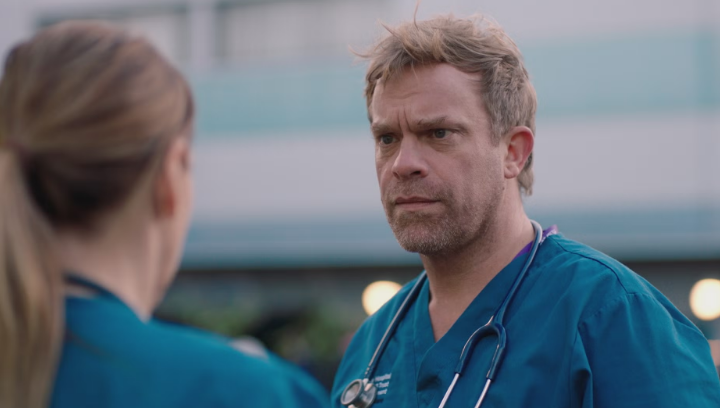
Dylan Keogh has become one of the most distinctive and emotionally complicated doctors in Casualty, a character whose journey through the years has been shaped by professional pressure, personal trauma, complicated relationships and an unwavering determination to protect his patients. When Dylan first became part of the Holby City Emergency Department, he quickly established himself as someone who could be difficult to understand. His dry humor, blunt manner and refusal to suffer fools made him appear cold at times, yet beneath that tough exterior was a doctor with an extraordinary commitment to his patients. Dylan’s approach to medicine was rarely sentimental, but that did not mean he lacked compassion. In fact, some of his most powerful moments came when his clinical instincts collided with his emotions. He could challenge colleagues, question authority and refuse to accept decisions he believed were wrong, even when doing so placed his own position at risk. Over the years, viewers gradually learned that his complicated personality was partly a defense mechanism. Dylan had experienced enough disappointment and loss to understand that emotional distance could sometimes feel safer than vulnerability. Yet the emergency department repeatedly forced him to confront the very emotions he tried to suppress. Every difficult patient, unexpected death and personal crisis tested his ability to remain detached. His career became a constant balancing act between being the calm professional everyone needed and the deeply human individual struggling behind the scenes. Dylan’s relationships with colleagues also helped reveal different sides of his personality. While he could be impatient with people he considered careless, he was fiercely loyal when someone had earned his trust. Younger members of staff could benefit from his experience even when his teaching style was intimidating, and colleagues who initially disliked his attitude often discovered that they could rely on him when a genuine crisis occurred. His reputation as a highly capable emergency doctor grew because he consistently demonstrated that when lives were at stake, Dylan could put personal disagreements aside and focus on the patient. That professional dedication became one of the defining features of his character. However, the longer he worked at Holby, the more obvious it became that medicine could not protect him from personal pain. The emergency department might give him a purpose, but it could not prevent old wounds from resurfacing. Dylan’s journey therefore became more than the story of a doctor developing his career. It became the story of a man learning, often painfully, that strength does not mean refusing to feel anything. His journey through the years would repeatedly test that lesson.
One of the most compelling aspects of Dylan’s story has been the way his professional confidence contrasts with his personal vulnerability. At work, he could appear almost unshakeable. He could walk into a chaotic emergency, assess a patient and begin directing treatment while others were still processing what had happened. But outside the clinical environment, Dylan could struggle with uncertainty and emotional situations that could not be solved through medical knowledge. This contrast made him especially compelling because viewers could see that the doctor who appeared to have an answer for everyone else did not always know what to do with his own problems. His relationships became particularly important in exposing that vulnerability. Dylan could develop strong connections with people around him, but his guarded nature often made those relationships complicated. He might care deeply about someone while struggling to express it, creating misunderstandings that became increasingly painful. The hospital environment also created unique challenges because colleagues were not simply friends or romantic partners; they were people with whom Dylan had to work during some of the most stressful moments imaginable. A disagreement outside work could quickly become a professional problem, while a crisis on a shift could force two people with unresolved feelings to cooperate. Dylan’s history also meant that trust was never something he gave away easily. When someone betrayed that trust, his reaction could be intense. Yet when he did allow someone into his inner circle, his loyalty could be equally powerful. This emotional complexity was particularly evident whenever Dylan faced situations involving vulnerable patients. He could become visibly affected by cases that reminded him of his own experiences, even if he tried to hide that reaction behind sarcasm or clinical professionalism. At times, his determination to save a patient could become almost obsessive. He might refuse to give up when others believed the situation was hopeless, pushing himself beyond reasonable limits. That dedication could be inspiring, but it could also expose one of Dylan’s greatest weaknesses: his tendency to carry responsibility as though every outcome depends entirely on him. When a patient died despite his best efforts, he could struggle to accept that medicine has limits. The emotional consequences might remain with him long after the shift ended. Colleagues could encourage him to talk, but Dylan was rarely comfortable admitting that he was struggling. Instead, he might return to work and bury himself in the next emergency. This cycle could make his professional life both his greatest strength and his greatest escape. Medicine gave Dylan purpose, but it could also allow him to avoid confronting emotions that demanded attention.
Dylan’s journey became even more complicated as he faced moments when his personal life and professional responsibilities collided. The emergency department can be an unforgiving environment, and Dylan was often forced to make decisions quickly while carrying emotional baggage that other people could not see. A patient could arrive whose circumstances triggered painful memories, or a colleague could become involved in a crisis that forced Dylan to confront feelings he had been suppressing. These moments could challenge his belief that clinical logic is enough to solve every problem. He might know exactly what treatment a patient requires while having no idea how to comfort a grieving relative. He could save a life but still feel helpless when confronted with emotional suffering that cannot be treated with medicine. Those contradictions became central to his development. Over time, Dylan could become more willing to recognize that being a good doctor does not require becoming emotionally invulnerable. He could learn to accept help from colleagues rather than automatically pushing everyone away. Yet progress would rarely be straightforward. Just when it seemed that Dylan had found greater emotional stability, another crisis could threaten to pull him backward. His struggles could also affect his work. Exhaustion, grief or personal conflict might make it harder for him to concentrate, forcing him to confront the uncomfortable reality that even an experienced doctor has limits. These storylines could give viewers a deeper understanding of the pressures faced by medical professionals. Dylan was not simply dealing with emergencies; he was also carrying the emotional aftermath of countless patients who passed through the department. Every successful resuscitation could bring relief, while every death could leave another memory behind. The cumulative effect could be enormous. Yet Dylan’s greatest quality remained his refusal to stop caring. Even when he became cynical, he could still fight fiercely for patients who had nobody else willing to fight for them. His compassion might not always look conventional. Instead of offering reassuring words, he might challenge someone to face reality. Instead of making a dramatic emotional speech, he might quietly stay beside a patient when everyone else had left. Those understated moments revealed the person behind the sarcasm. Dylan’s relationships with colleagues could similarly evolve as people learned to interpret his unusual way of showing concern. Someone who once saw him as arrogant might eventually realize that his bluntness often came from wanting people to survive. A junior doctor could initially resent his criticism but later recognize that Dylan was pushing them to become better. These relationships helped transform him from an isolated professional into a central figure within the hospital community. He was still difficult, still stubborn and still capable of making mistakes, but he was no longer simply the emotionally guarded doctor who arrived with something to prove.
As the years passed, Dylan’s greatest challenges increasingly became questions of identity, resilience and whether it was possible to build a meaningful life while constantly confronting trauma. The emergency department had changed around him, colleagues had come and gone, and the hospital itself had experienced countless crises, but Dylan remained a familiar presence. His longevity allowed viewers to see how much experience had shaped him. He had witnessed new doctors arrive full of confidence and then struggle with the realities of emergency medicine. He had watched colleagues leave, relationships change and patients survive against impossible odds. Each experience added another layer to his character. Yet longevity also came with a cost. Dylan could begin questioning whether he still belonged in the same environment or whether remaining in the emergency department had become another way of avoiding change. The possibility of leaving could therefore become emotionally significant. Would he really walk away from a career that had defined so much of his identity? Or would he decide that the hospital remained where he could make the greatest difference? These questions could become particularly powerful when Dylan experienced another major personal setback. He might feel exhausted by the constant cycle of crisis and recovery, wondering how much more he can take. A colleague could encourage him to remember why he became a doctor in the first place. The answer may not be complicated. He wanted to help people. Even after everything he had endured, that motivation could still be there. Dylan might therefore choose to remain, but with a different understanding of what it means to be strong. Instead of believing that he must handle everything alone, he could begin recognizing the value of connection. He may become more open with trusted colleagues, more patient with people who need emotional support and more willing to admit when a situation has affected him. That development would not erase his trademark personality. Dylan could still be sarcastic, stubborn and brutally honest. But his rough edges would no longer hide his entire emotional world. Viewers could see the difference between a man who refuses to care and a man who cares so much that he is afraid of what caring might cost him. His professional legacy could also become increasingly important. Younger doctors may look to him for guidance, even if they occasionally find his methods challenging. Dylan could become the kind of mentor who teaches through experience, warning others about mistakes he has already made. In doing so, he might finally realize that his years at Holby have given him something more than a career. They have given him the opportunity to influence the people who will carry the emergency department into the future.
Ultimately, Dylan Keogh’s journey through the years is compelling because it is not a simple story of a doctor becoming more successful. It is the story of a complicated man repeatedly forced to confront the limits of his own defenses. He entered the world of Casualty as a highly capable but emotionally guarded professional, someone who could handle medical emergencies with confidence while struggling to navigate the personal emotions that came with them. Over time, his relationships, professional challenges and encounters with tragedy revealed a much more vulnerable side. Dylan could be sarcastic because sincerity frightened him, distant because closeness created risk and stubborn because admitting uncertainty felt like weakness. Yet those same qualities could also make him fiercely loyal, determined and unwilling to abandon people who needed him. His journey through the emergency department showed that compassion does not always arrive in obvious forms. Sometimes it appears in a blunt warning, an argument over treatment or a refusal to give up on a patient everyone else believes is beyond saving. The years also taught Dylan that doctors are not immune to grief. They cannot save everyone, and accepting that reality may be one of the hardest lessons a medical professional can learn. Dylan’s development therefore came not from becoming less emotional but from becoming more willing to acknowledge his emotions. He could still struggle, still make mistakes and still retreat behind humor when life became overwhelming, but the difference was that he gradually became more capable of recognizing when he needed other people. His relationships with colleagues became an essential part of that growth, proving that even someone as guarded as Dylan could form meaningful bonds. His professional legacy also grew as younger staff members learned from his experience and saw the dedication behind his difficult exterior. Whether facing a chaotic emergency, a heartbreaking patient outcome or a deeply personal crisis, Dylan repeatedly demonstrated why he remained such a memorable figure at Holby City. His story is ultimately about resilience, but not the unrealistic kind that suggests strong people never break. Dylan’s resilience comes from breaking, struggling, learning and finding a reason to keep going. The emergency department may have tested him in ways he never expected, but it also gave him a purpose that continued to draw him back. Through triumphs and failures, love and loss, professional victories and painful mistakes, Dylan Keogh became much more than a doctor. He became a character whose imperfections made his strength believable. And that may be the most powerful part of his journey: after all the years, all the crises and all the reasons he had to walk away, Dylan continued to show up, step into the emergency department and try once again to save the next person who needed him.