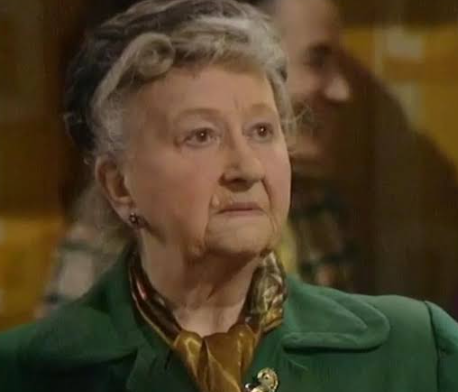
Margot Bryant remains a memorable name in the history of Coronation Street, remembered by longtime viewers for bringing warmth, humor and emotional depth to the world of Weatherfield. Her portrayal of the much-loved character Dr. Susan Cunningham gave the soap a distinctive presence during an important period in its history, but behind the television role was an actress whose later life became far more private and complicated. After leaving Coronation Street, Bryant stepped away from the relentless demands of television and gradually disappeared from the public spotlight, leaving fans to wonder what happened to the woman they had watched on their screens. Her final years were marked by a quieter existence away from the cameras, a stark contrast to the dramatic world of Weatherfield. Bryant had enjoyed a long career that extended beyond the cobbled streets, appearing in theatre, television and other productions before becoming associated with the ITV soap. Her time on Coronation Street gave her a place in British television history, but it was never the only part of her professional identity. Like many actors from earlier generations, she experienced the highs and uncertainties of a career in which work could be intense one moment and unpredictable the next. Leaving a successful television role could therefore mean entering a completely different stage of life. For viewers, however, characters can remain frozen in memory long after actors have moved on. Fans remembered the scenes, relationships and storylines, while Bryant continued living a life that was increasingly separate from the public attention created by her work. That distance became especially noticeable as the years passed and information about her private life became harder to find. Rather than constantly appearing in interviews or seeking publicity, she maintained a relatively low profile. This has contributed to the sense of mystery surrounding her later years. When an actor becomes less visible, people sometimes assume that something dramatic must have happened, but the reality can simply be that they chose privacy after decades of public work. Bryant’s story is therefore not only about the sadness associated with the end of a career chapter. It is also about what happens when an actor leaves behind a world where millions of people recognize their face and enters a much quieter personal existence. For those who remember her performances, the contrast can be surprisingly emotional. The lively television world where audiences knew her eventually became a distant memory, while the woman behind the character continued to age away from the spotlight.
The passage of time can be especially poignant for actors whose most famous work belongs to an earlier generation. Bryant’s connection with Coronation Street meant that her performance became part of the soap’s enormous archive of memorable characters, but television history does not always preserve the personal stories of the performers who created those roles. As new generations of viewers discovered the programme, many knew the characters without necessarily knowing much about the actors behind them. That can create a strange kind of separation. A performance remains alive through repeats, clips and memories, while the actor’s own life continues somewhere beyond the screen. Bryant experienced that divide as her career gradually moved away from mainstream television. Her decision to live more privately meant that there were fewer public glimpses into her day-to-day existence. For fans who had grown accustomed to seeing her on television, that disappearance could feel like another kind of farewell. There was no dramatic final episode announcing that her story had ended. Instead, her public presence simply became less frequent. This is one reason stories about an actor’s later years can become so emotional. Viewers naturally want to know what happened after the final appearance, particularly when they have formed a connection with a character. Yet the private years of an actor’s life should not be reduced to speculation. A quieter life does not automatically mean an unhappy one, and limited public information should not be treated as evidence of tragedy. What can be appreciated is the legacy Bryant left behind. Her work represented a generation of performers who built their careers through a mixture of theatre, television and demanding production schedules. They worked without the constant social media presence that defines celebrity culture today. Their private lives could remain genuinely private, and their careers were often remembered primarily through the characters they played. Bryant’s contribution to Coronation Street therefore deserves to be considered within that broader context. Her final years may have been far removed from the excitement of Weatherfield, but that does not diminish the importance of the work she had already completed. In fact, the distance between her public career and private life can make her story even more touching. She had spent years entertaining audiences, and eventually she was able to step away from that attention. For some performers, that transition may be exactly what they want. After years of having their lives shaped by production schedules, public expectations and professional commitments, privacy can become valuable. Bryant’s later life reminds viewers that the person behind a beloved character is entitled to become more than the role audiences remember.
There is also a deeper sadness in looking back at performers from classic soap eras because the television landscape they helped create has changed enormously. Coronation Street has continued evolving, with new characters, new technologies and new storytelling styles, while the faces associated with earlier decades have gradually disappeared from the programme. Bryant’s generation belonged to a period when soaps were becoming an increasingly important part of British popular culture, and performers could become familiar figures in millions of homes. Their characters could feel almost like members of the audience’s extended families. When those actors eventually retired or died, viewers often experienced a genuine sense of loss. Yet it is important to distinguish between the emotional language of a headline and the facts available about a person’s life. Calling an actor’s final years “tragic” can create an impression that may not accurately reflect the private reality. In Bryant’s case, the more responsible way to understand her later period is to recognize that she lived increasingly outside public attention rather than filling gaps with unsupported claims. The absence of regular media coverage does not tell us everything about someone’s wellbeing, relationships or circumstances. What we can say is that the contrast between her earlier public career and later privacy became increasingly pronounced. That change can feel dramatic because fans often imagine that actors continue living lives as visible as their television characters. In reality, many performers eventually choose ordinary routines and personal independence. Bryant’s decision to step back from the spotlight can therefore be seen as part of a natural life transition rather than simply an unhappy ending. Her professional achievements remained behind her, while her personal life belonged to her. For audiences, the temptation is always to imagine another chapter, perhaps a triumphant return to television or a final interview revealing everything that happened after Coronation Street. But real life rarely follows such neat storytelling patterns. People change careers, move away from public attention and develop priorities that have nothing to do with the roles for which they are remembered. Bryant’s story is compelling precisely because it reminds us of that reality. The character may have belonged to Weatherfield, but the actress belonged to herself. Her final years were not another soap storyline waiting for viewers to decode. They were part of a private life that existed beyond the cameras.
Looking back at Margot Bryant’s career also highlights how powerful television memories can become. Viewers may remember particular scenes, expressions or moments from Coronation Street decades after they originally aired. Those memories can remain vivid even when the actor has long since moved away from the role. That is the strange durability of soap opera. Characters leave, stories end and generations change, but audiences continue discussing performances that made an impression. Bryant’s work became part of that tradition. Her contribution may not have involved the most sensational storylines in the programme’s history, but memorable television does not always depend on explosive twists. Sometimes an actor’s greatest achievement is making a character feel believable enough that audiences care about them. Bryant brought that quality to her work, helping create a character who could exist naturally within the complex social world of the Street. Her later absence from television did not erase that contribution. If anything, it gave fans an opportunity to look back and appreciate the work with greater perspective. There is something bittersweet about discovering that an actor whose performances once filled television screens eventually lived quietly away from them. It reminds audiences that careers have beginnings, peaks and endings, while the memories created by those careers can continue indefinitely. Bryant’s story also reflects the changing nature of celebrity itself. Earlier actors could become widely recognizable without having every aspect of their private lives documented online. Today, viewers can follow performers constantly through social media, interviews and digital platforms. The level of public visibility is dramatically different. Bryant belonged to an era when stepping away from television could genuinely mean stepping away from public attention. That privacy should be respected rather than interpreted as evidence of hidden drama. Her later years may not provide the sensational ending that a soap-inspired headline suggests, but they offer something more meaningful: a reminder that a successful career can eventually give way to a quieter life. The applause fades, the cameras stop rolling and the audience moves on, but the person behind the performance remains. For Bryant, that transition was part of a much larger journey that began long before Weatherfield and continued after she left it.
Ultimately, the story of Margot Bryant’s final years after Coronation Street is best understood not simply as a tale of tragedy, but as a reflection on fame, privacy, aging and the lasting power of television memories. Bryant gave audiences a significant body of work and became part of the history of one of Britain’s most enduring television programmes. After leaving the spotlight, she lived a much more private existence, and that change naturally created curiosity among fans who remembered seeing her regularly on their screens. But privacy should not automatically be turned into a dramatic narrative. The most respectful tribute is to celebrate what is known: her professional achievements, her contribution to Coronation Street and the emotional connection audiences formed with her performances. The passage of time inevitably changes the relationship between viewers and the actors they once watched every week. A familiar face can disappear from television, yet the character remains alive in memories. That is perhaps the most powerful legacy an actor can leave. Bryant did not need to remain permanently in the spotlight for her work to matter. Her performances became part of a television history that continues to be revisited by longtime fans and discovered by new audiences. Her later years may have been quieter than the dramatic world of Weatherfield, but quiet does not necessarily mean empty, and the absence of public information should never be mistaken for proof of suffering. What makes her story bittersweet is simply the knowledge that time moves forward. The sets change, familiar faces leave and eventually entire generations of performers become part of television history. Yet the emotional impact of their work can survive. For fans of Coronation Street, remembering Bryant is therefore about more than wondering what happened after her final appearance. It is about recognizing the talent that helped make the programme what it became and appreciating the human being behind the character. The cameras may have stopped following her, but audiences never completely forgot the impression she left. In that sense, her legacy is not defined by the circumstances of her final years. It is defined by the years before them, by the roles she played, the viewers she entertained and the place she earned in the long and remarkable history of British television.