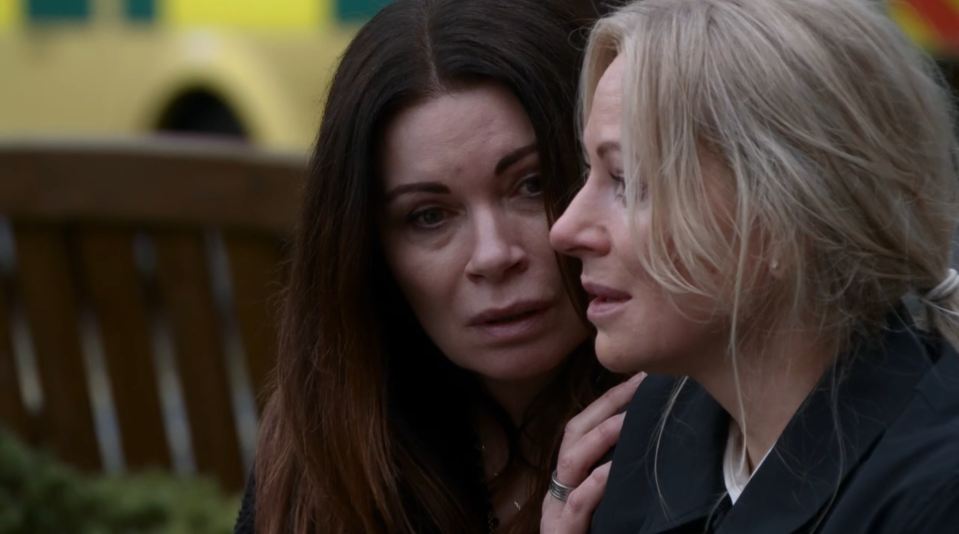
Betsy Swain has been fighting an incredibly difficult battle ever since the shocking medical emergency that changed her life. For weeks, the young woman has been forced to confront physical limitations, emotional exhaustion, and a level of dependence she never expected to experience. But just when it seems as though Betsy might finally be making progress, a quiet conversation with her mother, Lisa, reveals that there is another battle taking place beneath the surface.
And this time, it has nothing to do with physiotherapy.

Betsy is lonely.
That simple confession could become one of the most heartbreaking moments in her entire recovery story, especially because it exposes just how much pain she has been hiding from the people around her.
The ordeal began when Betsy collapsed at home after suffering a stroke during an intimate moment with Dylan Wilson. The incident was completely unexpected, leaving her family horrified and forcing Betsy into a frightening new reality almost overnight. The consequences were devastating. Her speech became affected, her mobility was severely reduced, and many of the everyday freedoms she had always taken for granted suddenly disappeared.
Since then, life at number six has revolved around rehabilitation.
Betsy has had to endure exhausting physiotherapy sessions, speech exercises, and the frustrating process of learning how to perform ordinary tasks again. Things that once happened automatically now require concentration, patience, and sometimes assistance from another person.
For someone who had always been independent and strong-willed, that loss of control has been particularly painful.
Yet the physical consequences of the stroke are only one part of Betsy’s struggle.

The longer she remains inside the house, the more isolated she seems to become. She has barely ventured outside for weeks, repeatedly rejecting Lisa’s attempts to persuade her to get some fresh air or reconnect with the world around her. Number six has become a strange combination of sanctuary and prison.
Inside those walls, Betsy is protected from curious looks and uncomfortable questions.
But she is also trapped with her own thoughts.
Every visitor means another opportunity for people to see how much she has changed. Every attempt to move around reminds her of what she could do before the stroke. And every time she struggles with something simple, there is another painful reminder that her recovery is nowhere near finished.
That emotional burden has also affected Betsy’s friendships.
Lauren Bolton was expected to be one of the people standing firmly beside her during this difficult period. Unfortunately, their friendship has been tested repeatedly.
The biggest clash between them came over Dylan’s involvement in the circumstances surrounding Betsy’s stroke. While Lauren wanted Dylan to face responsibility for what happened, Betsy refused to blame him.
That decision left Lauren furious and confused.
Was Betsy protecting Dylan because she still cared about him? Was she refusing to confront what had happened because the truth was simply too painful? Or was avoiding blame the only way she could emotionally survive everything that had happened?
Whatever the reason, Betsy’s position created a major divide between the two friends.
Their argument became so heated that Lauren eventually stormed out, leaving Betsy alone at a time when she was still struggling to move around safely.
The consequences were heartbreaking.
Unable to reach the bathroom without help, Betsy suffered an accident that left her humiliated and devastated. It was a brutally vulnerable moment that exposed just how much assistance she still needed.
When Carla learned what had happened, she was understandably furious.
From Carla’s perspective, Lauren had abandoned someone who was physically incapable of looking after herself properly. Her anger forced Lauren to confront the seriousness of her actions, and eventually Lauren returned to Betsy, apologized, and attempted to repair their friendship.
On the surface, peace was restored.
But emotional wounds don’t disappear simply because someone says sorry.
And that becomes increasingly obvious when Lauren visits Betsy again.
After Lauren eventually leaves, Betsy finds herself alone with Lisa. There is no dramatic confrontation or explosive argument. Instead, Betsy quietly admits something that may be far more revealing.
She tells Lisa that she feels lonely.
For Betsy, that admission is enormous.
She has spent so much time trying to appear strong that acknowledging her loneliness means finally allowing someone to see the emotional damage the stroke has caused. This isn’t simply about having fewer people around her. Betsy is surrounded by people who care about her, yet she still feels completely disconnected from the life she once knew.
And Lisa is now forced to recognize that her daughter’s recovery isn’t just physical.
Lisa has already tried encouraging Betsy to leave the house and experience something beyond the same familiar rooms. But hearing Betsy openly admit that she feels alone could change Lisa’s approach completely.
Will Lisa become more determined to help her daughter reconnect with the outside world?
Could she encourage Betsy to seek additional emotional support?
Or will Lisa simply realize that sometimes the most important thing she can do is sit beside her daughter and allow her to feel what she is feeling without trying to immediately fix it?
The timing of Betsy’s confession is especially significant because there is finally a small piece of good news waiting for her.
The following day, Betsy experiences a major breakthrough during physiotherapy.
For the first time since suffering the stroke, she manages to stand without assistance.
It is a remarkable achievement.
After weeks of frustration and setbacks, Betsy finally has tangible proof that all her hard work is producing results. For a brief moment, there is genuine hope that her recovery could be moving into a new phase.
Lauren is thrilled and wants to celebrate the milestone.
She arrives with a cake, intending to turn Betsy’s achievement into a special occasion. But there is one problem.
She doesn’t come alone.
Lauren brings Ollie Driscoll with her.

That decision could make an emotional moment far more complicated than Lauren realizes. Betsy’s history with Ollie is already complicated, and his unexpected appearance could change the atmosphere completely.
What should have been an intimate celebration between two friends suddenly becomes something larger.
Instead of simply enjoying her achievement, Betsy may once again feel pressured to respond to everyone else’s expectations.
There is an uncomfortable pattern developing here.
Lauren genuinely wants to help Betsy, but her attempts at support don’t always match what Betsy actually needs.
That was already obvious during an earlier visit, when Betsy was struggling with loneliness while Lauren was physically beside her but emotionally distracted, spending her time messaging Ollie on her phone.
The contrast is painful.
Betsy is finally opening up about feeling forgotten, yet the friend who should be closest to her isn’t fully engaged in the conversation.
For someone already battling isolation, that kind of emotional distance could be devastating.
Lauren may believe that simply turning up is enough, but Betsy’s situation requires something deeper. She needs someone who listens, understands her fears, and recognizes that recovery isn’t only about learning to stand or walk again.
Eventually, Lauren decides that the best way to help is to get Betsy out of the house.
She arrives with a plan.
The two of them are going to the bistro.
And Lauren makes it clear that she isn’t really asking.
Her intentions may be good. Betsy has spent weeks avoiding the outside world, and Lauren probably believes that a change of scenery will help her regain confidence.
But there is a major difference between encouraging someone and pushing them before they’re emotionally ready.
Unfortunately, the outing quickly becomes uncomfortable.
While at the bistro, Betsy accidentally knocks some cutlery onto the floor. Under normal circumstances, it would be nothing more than an insignificant mistake.
But Betsy isn’t living under normal circumstances anymore.
Every small physical mishap now feels magnified.
Lauren rushes to pick everything up, drawing attention to the situation. Then Debbie Webster notices what has happened and makes a careless joke, suggesting that Betsy must be drunk.
The remark may have been intended as harmless humor.
For Betsy, however, it could be crushing.
She has only just begun testing herself in public again. She has already admitted to Lisa that she feels lonely and vulnerable. Now, in front of other people, she is being mocked at precisely the moment she is trying to prove that she can still participate in ordinary life.
The cruel irony is impossible to miss.
Lauren wanted to help Betsy overcome her fear of leaving home, but the bistro incident could end up reinforcing every reason Betsy has been hiding inside number six.
Instead of feeling stronger, she may feel embarrassed.
Instead of feeling independent, she may feel exposed.
And instead of seeing the outside world as somewhere she can return to, she may begin viewing it as another place where people will judge her.
The aftermath could therefore be extremely important.
If Betsy retreats back into isolation, Lisa may become increasingly concerned. She now knows her daughter is emotionally struggling, and another humiliating experience could convince Lisa that stronger intervention is necessary.
Carla may also have something to say if she discovers what happened.

Given how fiercely protective she has already been of Betsy, Debbie’s comment could easily become another source of conflict.
Meanwhile, Lauren may finally have to ask herself whether her approach is actually helping.
She clearly cares about Betsy. She continues to visit and tries to encourage her. But good intentions cannot erase the consequences of repeatedly making decisions on someone else’s behalf.
Betsy’s recovery is proving that physical progress and emotional progress do not always happen at the same speed.
She can stand again, but that doesn’t mean she feels confident.
She may eventually walk, but that doesn’t mean she is ready to face a crowded room.
And she may physically regain her independence while still feeling emotionally lost.
That could be the real heart of Betsy’s storyline moving forward.
Her greatest challenge may not be learning to use her body again, but learning how to see herself differently after everything that has happened.
For now, one thing is certain: Betsy’s heartbreaking confession to Lisa has opened a door that can no longer easily be closed.
She has admitted that she feels alone.
The question is whether the people around her will finally understand what she is truly asking for.
Does Betsy need more encouragement, or does she simply need someone willing to listen?
Will Lisa become the person who helps her rebuild her confidence?
Can Lauren learn to support Betsy without pushing her too far?
And after the humiliating incident at the bistro, will Betsy retreat behind closed doors once again?
Her road to recovery is clearly not going to be simple.
There will be victories, setbacks, painful memories, and moments when even the smallest achievement feels enormous.
But perhaps Betsy’s confession to Lisa is itself a breakthrough.
For the first time, she is no longer pretending that everything is fine.
And sometimes, admitting that you are struggling is the first real step toward finding your way back.