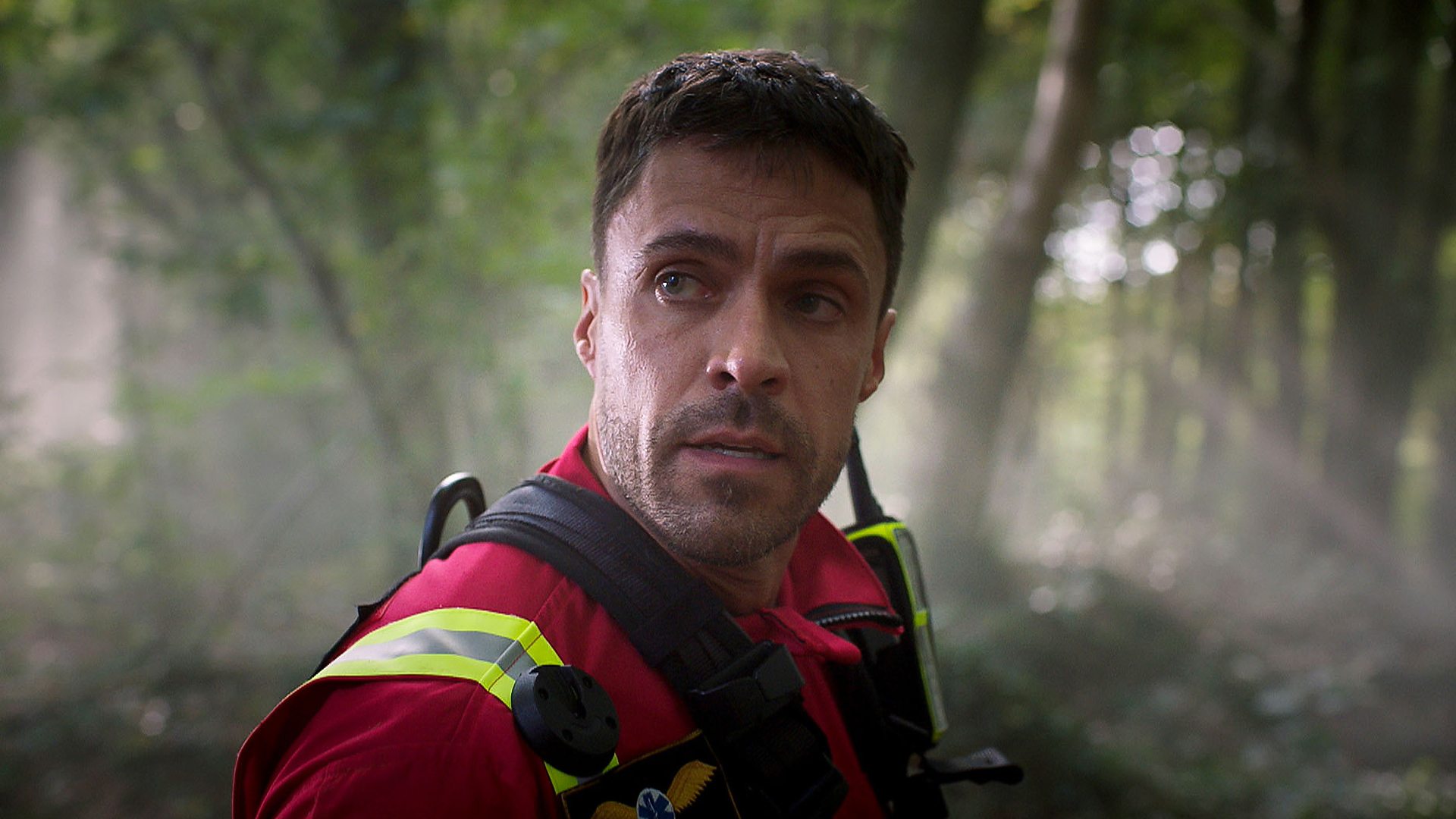
The shocking conclusion to Casualty’s “Lethal Legacy” storyline leaves Stevie Nash furious, devastated and questioning everything she thought she knew about Flynn Byron after he refuses to continue fighting for Colonel Jack Bard’s life. What begins as another desperate medical emergency rapidly becomes something far more personal when Flynn is forced to confront the man who has haunted his past. Jack has been at the centre of Flynn’s darkest memories, with his cruel treatment of soldiers and the death of Flynn’s friend Adam exposing a history of abuse that Flynn has struggled to overcome. Throughout “Lethal Legacy,” Flynn has tried to expose Bard’s behaviour, only to discover that official investigations have stalled and that the colonel’s influence remains frighteningly powerful. When Bard is shot at the barracks, Flynn initially risks everything to get him to safety, even ignoring police instructions because he knows the wounded man may not survive if treatment is delayed. Yet the decision that follows is one Stevie can barely comprehend. After Bard arrives at the hospital and his condition deteriorates, Stevie and Flynn initially work together to save him. They perform emergency treatment, prepare him for further intervention and fight against the clock as his blood loss becomes critical. But when Bard finally collapses and loses consciousness, Stevie orders Flynn to begin chest compressions. Instead, Flynn steps back. He refuses to act, leaving Stevie horrified as she continues the fight herself. In that moment, the professional partnership between them is shattered by something far more complicated than a disagreement over treatment. Flynn is no longer simply a doctor making a clinical judgment. He is a man standing face-to-face with someone responsible for enormous pain in his life, and Stevie is forced to witness the consequences of that unresolved trauma.
For Stevie, there is a fundamental principle that cannot be compromised: when a patient still has a chance, medical professionals must fight for that patient. She cannot simply accept Flynn’s decision, especially when she believes there was still something they could have done. The emergency becomes a devastating test of her faith in him. Stevie has worked alongside Flynn, trusted his judgment and relied upon his ability to remain calm when everyone else is under pressure. But when he refuses to perform CPR on Bard, she sees a side of him that frightens her. Her anger is intensified by the fact that Flynn does not appear immediately remorseful. Instead of expressing regret, he insists that Bard was never going to survive. That response cuts deeply because Stevie cannot reconcile the Flynn she knows with the man who appears emotionally detached from a dying patient. After Bard is later confirmed dead, Stevie confronts Flynn over what happened, making it clear that she believes he should have acted sooner. Flynn maintains that the outcome would not have changed, but Stevie refuses to accept that explanation. Her response is not simply professional outrage. There is heartbreak behind it. She has watched people die before, and she understands that doctors cannot save everyone. But what disturbs her is the sense that Flynn made a conscious decision to stop fighting. To Stevie, that distinction matters. She knows medicine sometimes reaches a point where treatment becomes futile, yet this was different because Flynn’s decision was deeply connected to his personal history with Bard. She may begin asking whether Flynn was capable of separating his role as a doctor from the anger he carried as a former soldier. If he could not, then the implications are enormous. How can Stevie trust him in another life-or-death situation? How can she work beside him knowing that his personal demons might influence his professional decisions? And perhaps most painfully, how can she believe his judgment when she now knows exactly how much hatred he has been carrying beneath the surface?
Flynn’s decision becomes even more disturbing when the full history between him and Bard is considered. The colonel was not simply an unpleasant former superior. He represented a traumatic chapter in Flynn’s life, one that had continued to shape his behaviour years later. Flynn had become increasingly determined to expose Bard after discovering evidence that soldiers under his command had suffered mistreatment, including injuries that did not match the official explanations surrounding military training incidents. His suspicions intensified as he uncovered more about Bard’s methods and the damage those methods had caused. The most revealing moment comes when Bard admits that his apparent protection of another victim was never motivated by compassion. He wanted to break her himself. That confession strips away any possibility that Flynn has misunderstood the man he has spent years fearing and resenting. Bard’s philosophy is brutally clear: weakness must be destroyed and soldiers must be hardened through suffering. His treatment of Flynn and others was part of that disturbing belief system. When Bard finally lies dying, Flynn is confronted with a horrifying choice. He can allow his medical instincts to take control, or he can finally refuse to save the man who caused so much pain. His decision suggests that the past has not been buried at all. It has been waiting beneath the surface, ready to return when Flynn is placed under unbearable pressure. That is what makes the moment so tragic. Flynn may believe he is finally taking control of his own life by refusing to save Bard, but Stevie sees something completely different. She sees a man still trapped by the influence of his former commander. In trying to defeat Bard, Flynn may have allowed the colonel’s worldview to dictate one of the most important decisions of his career.
The fallout is likely to be devastating because Stevie and Flynn are no longer arguing about a medical procedure; they are confronting a fundamental difference in their understanding of responsibility, compassion and justice. Stevie believes that the patient in front of her must remain the priority regardless of who that person is or what they have done. Flynn has reached a point where Bard’s actions have become so personal that professional detachment appears impossible. That conflict could permanently change their relationship. Stevie may struggle to forgive him, while Flynn may feel that she has failed to understand what Bard did to him and the other soldiers. Neither position is easy to dismiss. Stevie is right to be disturbed by a doctor refusing to act, but Flynn’s psychological connection to Bard cannot simply be ignored either. His actions emerged from years of fear, anger and unresolved trauma. The tragedy is that both realities can exist at once. Flynn can be a dedicated doctor and still be profoundly damaged by his past. Stevie can understand his suffering while remaining furious about what he did. The situation also raises questions about what happens next for Flynn professionally. A decision made in such a highly charged emergency could have consequences if it is scrutinised by colleagues or hospital authorities. Stevie herself may have to decide whether she can remain silent about what she witnessed. Yet this is not necessarily a story about punishment alone. It is also about whether Flynn can finally confront the emotional damage Bard left behind. If he simply convinces himself that he was right and refuses to examine why he acted as he did, the trauma could continue controlling him. For Stevie, the real fear may be that the man she thought she understood has been changed by a past he never truly escaped.
Ultimately, Jack Bard’s death closes one chapter of “Lethal Legacy” but opens an even more complicated one for Stevie and Flynn. The colonel is gone, but the damage he caused remains alive inside the people he manipulated and abused. Flynn may believe that Bard finally lost the power to hurt him, yet Stevie’s furious reaction suggests that the consequences of his final decision could haunt him for a long time. The tragedy is that Flynn once risked his own safety to get Bard out of the barracks, only to stand back when the man finally needed him most. That contradiction says everything about the emotional battle taking place inside him. Stevie, meanwhile, must decide what Flynn’s actions mean for the trust between them. She cannot simply forget what she saw, and the fact that Flynn appeared unmoved when told Bard had died only deepens her concern. Their relationship could now become one of the most emotionally complicated dynamics in the ED, especially as both characters struggle to determine whether what happened was an unforgivable betrayal or the desperate act of a traumatised man finally breaking under years of pressure. “Lethal Legacy” has always been about the way the past can return and shape the present, and Flynn’s refusal to save Bard may be the clearest demonstration of that theme yet. Bard wanted to create soldiers who believed weakness had to be crushed, but his final confrontation with Flynn may prove that buried pain cannot simply be transformed into strength. Stevie knows that. Flynn may not. And as the dust settles on Bard’s death, the question haunting Holby City Hospital is no longer whether Flynn could have saved Jack. It is whether Flynn can save himself from becoming the very kind of man Bard tried to create.
Stevie Is Furious After Flynn Refuses To Save Jack | Lethal Legacy | Casualty